
How Big Should a Bistro Table Be?
For two people, a bistro tabletop measuring roughly 60 to 80 cm across is a useful starting range to test. A smaller surface may suit coffee and a snack; larger plates and shared dishes need more room. When choosing balcony bistro set patio furniture, measure the table with its chairs in use and check that the balcony door and walking route stay clear.
The right size depends on your meals, the chairs, and the balcony’s shape. Use the measurements below as planning examples, then test your intended setup before ordering.
What Size Bistro Table Works for Two People?
A small bistro table can work well for drinks, but eating a full meal changes what you need from the surface. Start with the number of place settings you expect to use every day. Include the items that usually sit between them, such as a serving bowl or water jug.
|
Tabletop to try |
Planning use |
What to check |
|---|---|---|
|
About 55 × 54 cm |
A compact option for drinks or a small breakfast |
Whether two place settings leave room for cups |
|
About 60 cm diameter |
A starting point for coffee or a simple meal for two |
Plate size and any shared dishes |
|
About 70 to 80 cm across |
More surface to test for two-person dining |
Whether chairs and access still fit the balcony |
Use these dimensions for a trial layout because seating comfort also depends on the chairs and table base. A wide armchair may take up more room around the table than a slim folding chair. Table legs can limit where someone sits, even when the tabletop looks large enough.
Joye Leisure’s balcony furniture selection guide covers the broader decision of matching seating and layout to your daily use.
Match the Tabletop to What You Serve
Make a paper or cardboard template in the size you are considering. Place your usual plates and glasses on it, then add the food you normally share. Check whether both people can reach their meal comfortably and set a drink down securely.
For morning coffee, a compact surface may be enough. If you eat dinner outside, include the serving dishes you actually use. A centrepiece or small plant takes up some of the same space, so add it to the test if you intend to keep one on the table.
Check the usable surface too. A broad rim, raised edge, or central parasol fitting may change where plates can sit. Product photos help show the design, while a dimension drawing is better for planning the layout.
Measure the Whole Balcony Bistro Set
The table’s width is only one part of the footprint. Chairs extend beyond its edge when someone sits down, and people need space to pull them back and stand up. Measure those movements with a chair similar in size to the one you plan to buy.
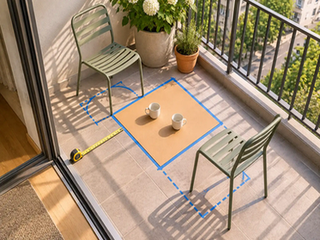
Mark the table outline on the balcony floor with removable tape. Position two chairs around it and try sitting down. Open the balcony door fully, walk past the occupied chairs, and check that you can reach anything you use regularly, such as a planter or storage box.
For example, a 120 cm-deep balcony with a 60 cm tabletop leaves 60 cm in that direction before allowing for the occupied chairs. That arithmetic alone says little about whether the arrangement works. Chair position and the route through the space determine how much usable room remains.
Test the full layout to find the clearance your table and chairs need. Keep the doorway and required access routes clear, and follow any building requirements that apply to your space.
Choose Between Round, Square, and Folding Tables
A round tabletop has no corners projecting into the surrounding space. That can suit an open seating area, although its diameter still needs to fit the available width. Check the base as well: crossed legs or a wide pedestal can affect foot placement.
A square or rectangular table has a straight edge that can sit alongside a wall. If you place it there, test where both people will sit and whether their knees clear the frame. An unused strip behind the table is still part of its footprint.
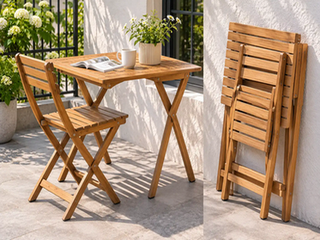
Folding furniture can free up the balcony between meals. Confirm the folded dimensions, the space needed to open it, and where it will be stored. Joye Leisure’s comparison of folding chairs and benches discusses the difference between seating space during use and storage.
Check Table Height and Chair Fit
Match the chair and table heights before buying separate pieces. Bistro sets may use dining-height seating or taller bar-style seating, so check the actual measurements. A table described as “bistro” does not specify its height by itself.
Measure from the chair seat to the underside of the table frame and check legroom. Armrests may prevent a chair from sliding underneath, while a thick cushion changes the height at which you sit. Crossbars can also interfere with feet.
Compare those details with a dining chair and table you already find comfortable. Joye Leisure’s outdoor furniture selection guide offers further checks on comfort and material care once the dimensions work.
Before Buying a Balcony Bistro Set
Use your measured layout to compare the final options:
Confirm the tabletop holds your usual place settings and shared dishes.
Check the chairs’ width and depth, including armrests.
Test sitting down, pulling a chair back, and walking through the balcony.
Make sure the door opens fully and required access stays clear.
Check table height, knee space, and the position of legs or crossbars.
Verify folded sizes and a storage location if you choose folding pieces.
Keep the marked layout in place long enough to try the movements you make each day. Choose the tabletop that holds your meals and leaves the complete set practical to use.